Learn
Hail vs Wind Damage: How Adjusters Tell the Difference
Hail bruises shingles. Wind lifts them. Adjusters look for very specific signatures of each — here's what they check, and why getting the cause right matters for your claim.
Why the cause of damage matters
When you file a roof claim, one of the first questions your carrier asks — sometimes before they even send an adjuster — is what caused the damage. Was it hail? Wind? Something else entirely? This isn't small talk. The answer determines which peril the claim is filed under, whether it's covered at all, which deductible applies, and how much evidence the carrier needs before it pays.
Most standard homeowners policies cover both hail and wind as named perils, so the distinction doesn't always change whether you get paid. But it can matter more than people expect. Some policies carry a separate, higher wind/hail deductible — often a percentage of your dwelling limit rather than a flat amount. Coverage for cosmetic damage or matching may be limited by endorsement for one peril and not the other. And in disputed claims, the carrier's position on the cause of loss is the foundation everything else is built on: if they say your damage is wear and tear rather than a covered storm event, the claim goes nowhere.
That's why it helps to understand what adjusters are actually looking for when they climb up on your roof. Hail and wind each leave a distinct signature, and trained inspectors check for those signatures methodically. Knowing what they check lets you walk your own roof with better eyes, document the right things, and speak the carrier's language when you disagree with a finding.
The hail signature: random bruising
Hail damage is, at its core, impact damage. Stones fall more or less straight down, striking the roof at whatever angle the roof presents to the sky. That randomness is itself a signature: genuine hail damage tends to appear scattered across slopes with no obvious directionality. Adjusters expect to see impacts distributed across multiple slopes — not lined up in a row, not confined to one convenient area.
On asphalt shingles, a hail hit typically shows up as a round or slightly irregular spot where granules have been knocked loose, exposing the darker asphalt mat underneath. Fresh hits look darker and softer; older ones weather and collect dirt. The real damage, though, is often what you can't see from standing position: the impact fractures the fiberglass mat beneath the granule layer, creating a soft spot. Adjusters press suspicious spots with a finger or thumb — a genuine hail bruise gives slightly under pressure, like a bruise on fruit. They may also circle impacts with chalk during inspection to map the pattern, which is why chalk marks on your shingles after an adjuster visit are normal.
Three things separate convincing hail damage from things that merely look like it. First, collateral damage: hail doesn't discriminate. If a storm hammered your roof, it usually also marked the soft metals — vents, gutters, downspouts, flashing, AC condenser fins. Adjusters check these surfaces because dents in gutters and vents corroborate a hail event in a way shingle marks alone can't. A roof with "hail damage" but pristine gutters and untouched vents raises questions. Second, functional vs. cosmetic: some policies (check your endorsements) limit or exclude cosmetic-only hail damage, paying only for damage that reduces the roof's function or lifespan. Third, the pattern itself: blisters from manufacturing defects, foot traffic scuffs, and granule loss from age all have their own looks, and adjusters see enough roofs to know them apart from impact bruising.
The wind signature: lifting and creasing
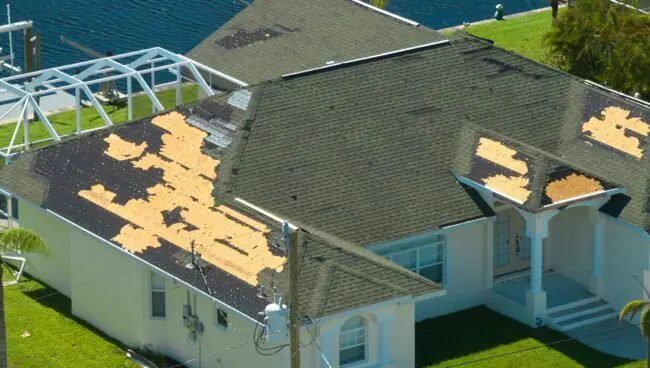
Wind damage works by force, not impact. Strong gusts get under shingle edges and lift them, stressing the adhesive sealant strip and the shingle mat. The classic wind signature is the lifted, creased, or missing tab. When a shingle lifts and folds back, it creases — and a creased shingle is a compromised shingle. Even if it lays flat again afterward, the crease is a permanent weak point where the mat has broken, and wind will tear it there next time.
Unlike hail's random scatter, wind damage usually shows directionality. You'll often see it concentrated on the windward slopes — the sides of the roof that faced into the storm — and along ridges, eaves, and rakes, where wind pressures are highest and shingles are most exposed. Adjusters look for this directional logic. They'll also do a simple physical test: gently lifting shingle tabs by hand to check sealant adhesion. On a healthy roof, the sealant strip holds firmly; on a wind-damaged one, tabs lift with little resistance, sometimes because the seal never properly bonded in the first place, sometimes because repeated wind cycles broke the bond.
Missing shingles are the most obvious wind evidence, but adjusters also note subtler signs: lifted nail heads, shingles that have shifted position, exposed fasteners, and displaced ridge caps. After a storm, they may also consider the storm's documented wind speeds and the condition of surrounding roofs — if the whole neighborhood lost shingles, a single denial looks harder to justify.
How adjusters test and document
An adjuster's roof inspection is more structured than it looks from the ground. For a suspected hail claim, the standard approach is a test square: the adjuster marks off a representative 10-by-10-foot section on each slope and counts qualifying hail impacts within it. Carriers set thresholds (a certain number of bruises per square) that define when damage is extensive enough to justify replacement rather than repair. The count, the slope-by-slope breakdown, and the photos go into the file. If you ever wonder why an adjuster spent twenty minutes chalking one small area, this is why.
For wind, the documentation is more narrative: which slopes, how many tabs affected, whether shingles are creased, displaced, or missing, and whether sealant failure is widespread or isolated. Photos matter enormously in both cases — and not just the adjuster's. Your own dated photos of missing shingles, debris, and gutter dents taken right after the storm carry real weight, because they show conditions before any repairs or further weathering.
One more thing adjusters weigh heavily: storm date corroboration. Carriers cross-check your reported date of loss against weather records. A hail claim filed for a date when no hail was recorded in your area is an uphill fight. If you're unsure exactly when the damage happened — common with hail, which often isn't visible from the ground — say so honestly, and let your contractor or documentation narrow the window to a documented storm.
What homeowners usually get wrong
- Assuming all granule loss is hail damage. Shingles shed granules as they age. Uniform granule loss across an old roof is typically wear, not a covered peril.
- Confusing blisters with hail hits. Blisters are a manufacturing/weathering defect — raised bubbles in the shingle. They look similar from a distance but have no impact pattern and no mat fracture.
- Thinking one damaged slope means a full replacement. Carriers typically pay for what's damaged. Whether undamaged slopes get replaced depends on matching, state law, and your policy — not on how you feel about a patchwork roof.
- Waiting too long to document. Hail bruises weather and darken; wind-lifted tabs can re-seal in heat or tear off in the next storm. Photograph everything as soon as it's safe.
- Describing the cause with certainty you don't have. "There was a bad storm Tuesday and now shingles are missing" is honest and useful. "Category 4 hail destroyed my roof" invites skepticism if the data doesn't back it.
If your carrier denies a claim or attributes your damage to wear and tear, understanding these signatures is the starting point for a serious pushback. A detailed contractor inspection that documents the same patterns the adjuster looks for — random bruising, collateral hits, directional lifting — is often what turns a "no" into a reinspection. For more on that process, see our guide to what happens after you file a roof claim, and if a denial has already landed, the common reasons claims are denied and what to do about each.
Document it like a pro
Hail and wind each need different photo evidence — bruise close-ups and collateral shots for hail, lifted-tab and directional shots for wind. The Storm Damage Photo Guide ($27) shows you exactly what to shoot for each damage type, with checklists you can hand to anyone with a phone.